Canadian VIP Escort Profiles: Rates, Incall Options and Booking Guide
Canadians searching for VIP escorts usually want three things answered before they contact anyone: whether a listing is genuinely premium, what the quoted C$ rate actually includes, and how to book through a channel that does not expose them to a stream of unprotected messages. CANADALUST gathers Canadian escort profiles, photos, published rates and incall and outcall options for listings in Toronto, Vancouver and Montreal, and this article works through how to read those listings with the same discipline a careful buyer would apply to any other service. The guidance below builds on the core ideas of the parent piece, which argued that a luxury label means little unless the profile, the terms and the communication all support it. Learn more about how the parent overview frames these listings before you start comparing them.

Each city has its own market texture, and that texture affects what a good listing looks like. Toronto's downtown core and the Financial District carry a dense concentration of profiles, which makes it easier to compare options but also easier to be overwhelmed by near-identical presentations. Vancouver's Coal Harbour and Yaletown districts tend to draw more polished, hotel-adjacent listings, while Montreal's Plateau and Old Montreal present a different mix that often lists languages and neighbourhood details more prominently. In every case the same test applies: a premium profile names its area, states its availability windows and describes services in plain terms rather than in vague superlatives.
Read the rate and its inclusions in C$, decide between incall and outcall based on real constraints such as traffic and privacy, and complete everything through the protected checkout
- The meaningful comparison is between what each rate includes, how long it lasts and what conditions apply
- It removes the message history, the moderation and the payment protections that a site inbox provides
- The site also keeps messaging, checkout and agreement steps inside its own environment, so the record of what was agreed stays with the booking rather than scattered across personal apps
- Each step narrows the uncertainty, and none of them requires trusting a headline
Choosing a Verified VIP Escort Profile in Toronto, Vancouver and Montreal
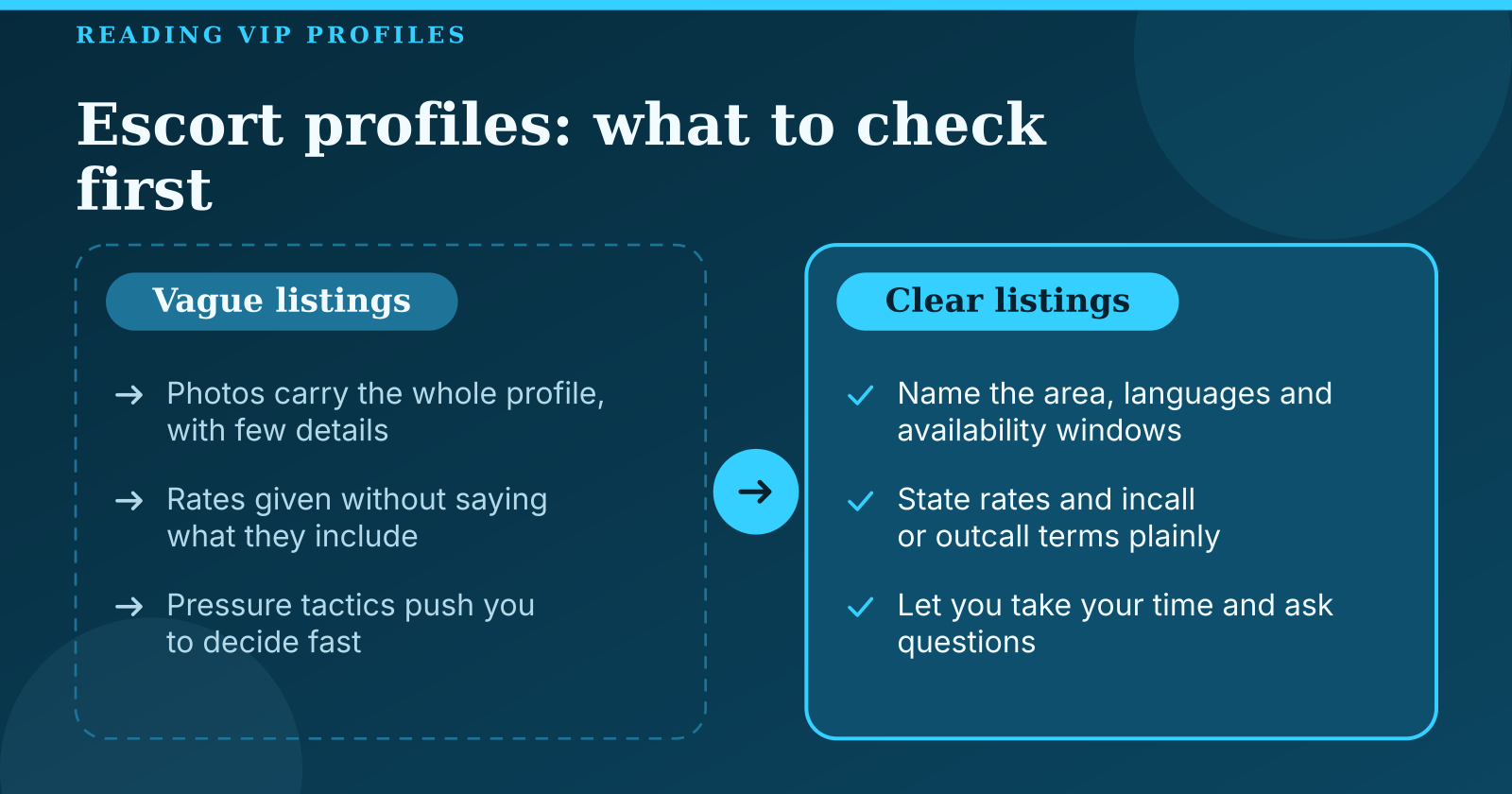
The listing format matters more than the photographs, because photographs are the easiest part of a profile to polish. A complete profile should state an age range, the languages spoken, the availability windows, the neighbourhoods served and the services described in ordinary language. When those fields are missing or vague, the photographs are doing all the work, and that is a weak basis for a decision. A listing that tells you exactly when and where it operates has given you something to check.
Separating genuinely high-end listings from generic classifieds comes down to consistency and specificity. A premium profile names the Toronto neighbourhood it serves, the Vancouver district it covers or the Montreal borough it prefers, and it keeps those details identical across the profile page, the rate section and the messaging. Generic classifieds tend to use the same template across dozens of unrelated names, and they lean heavily on urgency. Absence of pressure tactics is therefore itself a signal: a listing that lets you take your time and ask questions is behaving the way a professional service does.
What to Check Before You Message
Before sending a first message, check whether the profile is complete and whether the same details appear everywhere they should. A discrepancy between the age range on one page and the availability on another is worth noting, because it suggests the profile has not been maintained carefully. Read the rate section alongside the services list and confirm they describe the same thing, since mismatches here are a common source of later disputes.
Response style is the next test, and it is more revealing than most readers expect. A professional reply is specific: it answers the question asked, confirms the time window and states the terms without being asked twice. A vague or urgent reply, particularly one that pushes you to commit immediately, should lower your confidence in the listing. Watch for requests for upfront payment through untraceable methods, and treat any suggestion to move the conversation to an unmonitored messaging app as a red flag, because it removes the message history and moderation that a dedicated site inbox provides.
Verification Steps Used by Experienced Clients
Experienced clients ask reasonable, non-invasive questions that confirm the person described on the profile is the one who will attend the appointment. Asking which neighbourhood they work from, what languages they speak or how the booking will be confirmed tends to surface inconsistencies quickly without intruding on anyone's privacy. Anything that requires identification documents, financial account details or personal contact information outside the platform should be declined.
Confirming the booking channel is the platform's own system rather than a third-party redirect is a simple but important check. Once the arrangement has been agreed, keep a written record of the rate, the duration, the location and the time, and make sure these details are visible in the site's booking history. That record is the reference point if anything changes, and it is far more useful than a memory of a conversation carried on in a personal app.
Understanding What C$ Rates Actually Cover
Published rates in Canada are quoted in Canadian dollars and typically cover a time block, sometimes with separate figures for an hour, a longer block or an overnight arrangement. Rate bands vary by city and by duration, and they also shift with the time of day and the day of the week, with late evenings and weekends commonly priced differently from weekday daytime slots. Comparing any two rates only makes sense when the duration, the time window and the day are the same.
Overnight and extended bookings deserve particular attention, because the base figure often covers less than readers assume. Clarify whether the quoted sum includes a minimum block, whether additional time is charged in increments and whether any extras appear as separate line items. Where charges are likely to appear is usually in the gap between the advertised headline figure and the total agreed on arrival, so the sensible habit is to ask for the full picture in writing before the booking is confirmed.
Travel and location surcharges apply when a booking falls outside the agreed incall address, most often when a provider is asked to travel across town. Downtown Toronto, Vancouver's bridge-separated districts and Montreal's central neighbourhoods each have different travel costs and different time requirements, so a surcharge in one city may be comparatively small while in another it changes the total significantly. Ask whether any such fee applies before agreeing to a location that is not the stated incall address.
Itemising the Quoted Price
The distinction between the base time block and extras determines whether a quoted price is realistic. Confirm exactly which services are included in the block and which are charged separately, and do not assume that a service described on the profile falls under the headline rate. If the profile is unclear on this point, the clarity of the answer you receive is itself informative: a listing that itemises cleanly is easier to trust than one that responds with generalities.
Gratuity and deposit conventions differ across the Canadian market, and stating expectations early avoids awkward moments later. Ask whether a deposit is required to hold a booking, how it is applied to the final total and under what circumstances it is refundable. Clear, advance statements on these points are a hallmark of a professional listing, and they protect both parties from misunderstandings about money.
Payment methods accepted each have practical limits. Cash works for in-person settlement but leaves no record, card payment through a protected checkout creates a receipt and a dispute route, and e-transfer is convenient but should only be used when the booking is confirmed through the platform itself. Choose the method that gives you a traceable record of what was paid and for what.
Seasonal and Event-Driven Fluctuations
Demand changes across the year, and those changes shape both availability and pricing. Toronto and Montreal see spikes around major conferences, festivals and trade events, when hotel rooms are scarce and bookings fill quickly. Winter months in both cities tend to be quieter for certain categories of booking, which can make mid-week appointments easier to secure. Vancouver's rainy season and its summer tourism peak produce similar shifts in what is requested and when.
Holiday weekends affect availability in predictable ways. Canadian long weekends, which are set by Canada's own calendar, tend to compress the number of open slots and push rates upward for the most in-demand profiles. Planning ahead for these windows, and checking availability windows against the holiday dates rather than assuming a listing will be open, avoids the frustration of finding the best options already booked.
Booking an Incall Appointment Step by Step
A well-run incall booking starts with preparation. Settle on a confirmed budget in C$, decide the duration you actually need and make sure you can be reached for confirmation. Arriving with unclear expectations about money or time is the most common source of friction, and the preparation takes only a few minutes.
The sequence that works in practice moves from initial enquiry to availability confirmation, then to agreement on rate and inclusions, followed by the address and arrival time and finally a reminder. Each step should be completed in writing through the booking channel, so that the terms are documented before anyone travels. Skipping a step, particularly the written agreement on inclusions, is the point at which expectations most often diverge.
On arrival, discretion and timekeeping set the tone for the appointment. Arrive within the agreed window, respect the boundaries that were stated in advance and treat the arrangement with the same courtesy you would expect in any professional service. Boundaries agreed in writing carry more weight than preferences raised for the first time in person.
Choosing an Incall Location
Assessing building access is a practical first step. In downtown Toronto, check whether the building has a reception desk, whether visitors must sign in and whether there is underground parking or reliable transit nearby. In Vancouver, consider how the location is reached across the city's bridges and whether the transit connection is direct. In Montreal, check whether the building is accessible by Metro and whether street parking in the chosen borough is restricted, since these details affect arrival time and the ease of the visit. Useful details.
Confirming the address through the booking channel is essential, and the address should match the neighbourhood stated on the profile. A mismatch between the two is a warning sign worth raising before travelling. Privacy matters for both parties, which is why building security and reception procedures should be considered in advance. A discreet arrangement depends on both sides knowing exactly how the visit will be handled at the door.
Timing and Confirmation
Arrival windows need to account for real traffic conditions. In Toronto, the Gardiner Expressway and the Don Valley Parkway can add significant delay at peak hours. In Vancouver, the Lions Gate and Massey crossings and the Highway 99 corridor can slow a trip considerably. Montreal's Ville-Marie corridor and its construction-heavy periods demand similar planning. Building a buffer into the arrival window prevents a late arrival from turning into a cancelled appointment.
A confirmation message sent shortly before the appointment, along with a brief check-in, prevents last-minute misunderstandings about the address, the time or any change in plans. Keeping this exchange inside the site's messaging system preserves the record and the moderation that protect both parties if something goes wrong.
Safety, Consent and Legal Context in Canada
The current Canadian legal framework is set by the Protection of Communities and Exploited Persons Act, which came into force in 2014. Under that Act, purchasing sexual services is criminal, while the selling of one's own sexual services is treated differently, and the law places particular emphasis on the protection of persons who are exploited. For anyone booking an appointment, the practical consequence is clear: avoid any arrangement that could be read as facilitating exploitation, and never engage with any person who is not an adult. Any listing that is unclear about age or that pressures a client to bypass verification should be rejected outright.
Personal safety practices follow from the same logic. Share only the information a booking actually requires, avoid sending identification or financial details through ordinary chat and be suspicious of any request that moves payment outside the platform. Keeping communication, terms and payment inside one environment gives you a trail to refer back to. Consent is not a formality: it should be clear, given freely and respected throughout the appointment, and either side should be able to end the arrangement at any point without pressure.
Protected Checkout and Site Inbox as Safeguards
A dedicated site inbox differs from a generic messenger in ways that matter for a booking. Messages stay attached to the listing in a single history, which creates a record of what was agreed. Moderation can address abusive or fraudulent behaviour in a way that an outside app cannot, and the arrangement does not require early exchange of personal contact details, which reduces exposure to unwanted follow-up. A protected checkout typically shows the terms before payment, asks for confirmation of the booking details and issues a receipt.
The discipline at checkout is to read the terms where they are presented rather than assume they match the profile. If the checkout asks for information unrelated to the booking, pause and find out why before proceeding. Comparing several listings is easier when their details line up across sections, because a profile that stays consistent from photographs to services is simpler to assess, and the same consistency is what makes the difference between a credible listing and a generic one.
How to Evaluate a VIP Escort Listing: A Criteria Checklist
A useful evaluation rests on a handful of signals rather than a single impression. Consistent photographs over time, clear and specific published terms, a transparent rate structure and professional, responsive communication together tell you more than any one feature does. No single signal is decisive, but a listing that performs well across several of them is generally a safer choice than one that excels on a single point.
Red flags are often easier to identify than strengths. Pressure to move the conversation off the platform, a price that shifts without explanation, a request for upfront payment through methods that cannot be traced or reversed, or images that appear recycled across unrelated names should each end the evaluation. Scoring each listing on transparency of terms, clarity of rates and inclusions, quality of communication and the protections offered by the booking process, and writing those scores down, keeps the comparison honest. A listing that scores low on transparency should not be rescued by attractive photographs.
Common Mistakes and How to Avoid Them
The most frequent error is trusting photographs alone. A striking image says little about whether a listing is current, consistent or run by the person pictured. Checking the stated terms, the neighbourhood references and the quality of communication gives a far fuller picture than first impressions do.
Readers also tend to assume that a high rate signals quality or that a low rate signals value. Neither assumption holds. Leaving cancellation and refund rules unread until after booking is a related mistake that is easy to avoid by reading them first.
Moving to an unprotected messenger is perhaps the most avoidable problem. Local timing factors, such as traffic on the Gardiner in Toronto, weather-driven delays in Vancouver and construction along the Ville-Marie corridor in Montreal, are also easy to underestimate, and they affect both logistics and the price a client ends up paying.
What the Platform Brings Together
CANADALUST consolidates Canadian escort profiles, photographs, published C$ rates and the incall and outcall options for each listing in one place, so that comparison does not require jumping between unrelated sources. For a reader looking for local escort services in Canada, that consolidation is the practical benefit: fewer unknowns, clearer terms and a process that can be followed from the first look at a profile to a confirmed appointment.
Conclusion
The strongest approach is a disciplined one. Start with the profile and check whether the photographs, the stated terms and the neighbourhood references agree. If a listing cannot answer your questions clearly, that is useful information in itself, and it is reason enough to move on to the next profile. Following these steps consistently turns a search for VIP escorts in Canada into a comparison of verifiable facts, which is what the parent article set out to achieve.